Cat#:Y05421H
Species:Human
Size:10μg/50μg/1mg
Purity:≥95%
Endotoxin: ≤10 EU/mg
Cat#:Y05421H
Species:Human
Size:10μg/50μg/1mg
Purity:≥95%
Endotoxin: ≤10 EU/mg
General description
Acidic Fibroblast Growth Factor is a potent mitogen and survival factor for fibroblasts, endothelial cells, and neural progenitors. It exhibits broad receptor specificity and strong affinity for heparin, making it a versatile tool for cell culture and tissue engineering applications. Recombinant Human FGF-1 Protein (Y05421NH) is expressed from E. coli cells. It contains AA Phe 16 - Asp 155 (Accession # NP_001127073.1), and is widely used in advanced cell culture, angiogenesis research, and neural development studies.
Application
· Fibroblast and Endothelial Cell Proliferation — Drives growth of mesenchymal and vascular cell types in serum-free conditions.
· Neural Stem Cell Survival and Differentiation — Supports the maintenance and neuronal commitment of CNS progenitors.
· Angiogenesis and Vascular Sprouting — Models blood vessel formation in endothelial tube formation and spheroid assays.
· Wound Healing and Tissue Repair — Promotes granulation tissue formation and re-epithelialization.
· Serum-Free Culture Systems — Suitable for chemically defined and xeno-free cell culture media.
Product Specifications
| Cat. No. | Y05421NH |
| Purity | ≥95%, by SDS-PAGE |
| Endotoxin | ≤10 EU/mg by the LAL method |
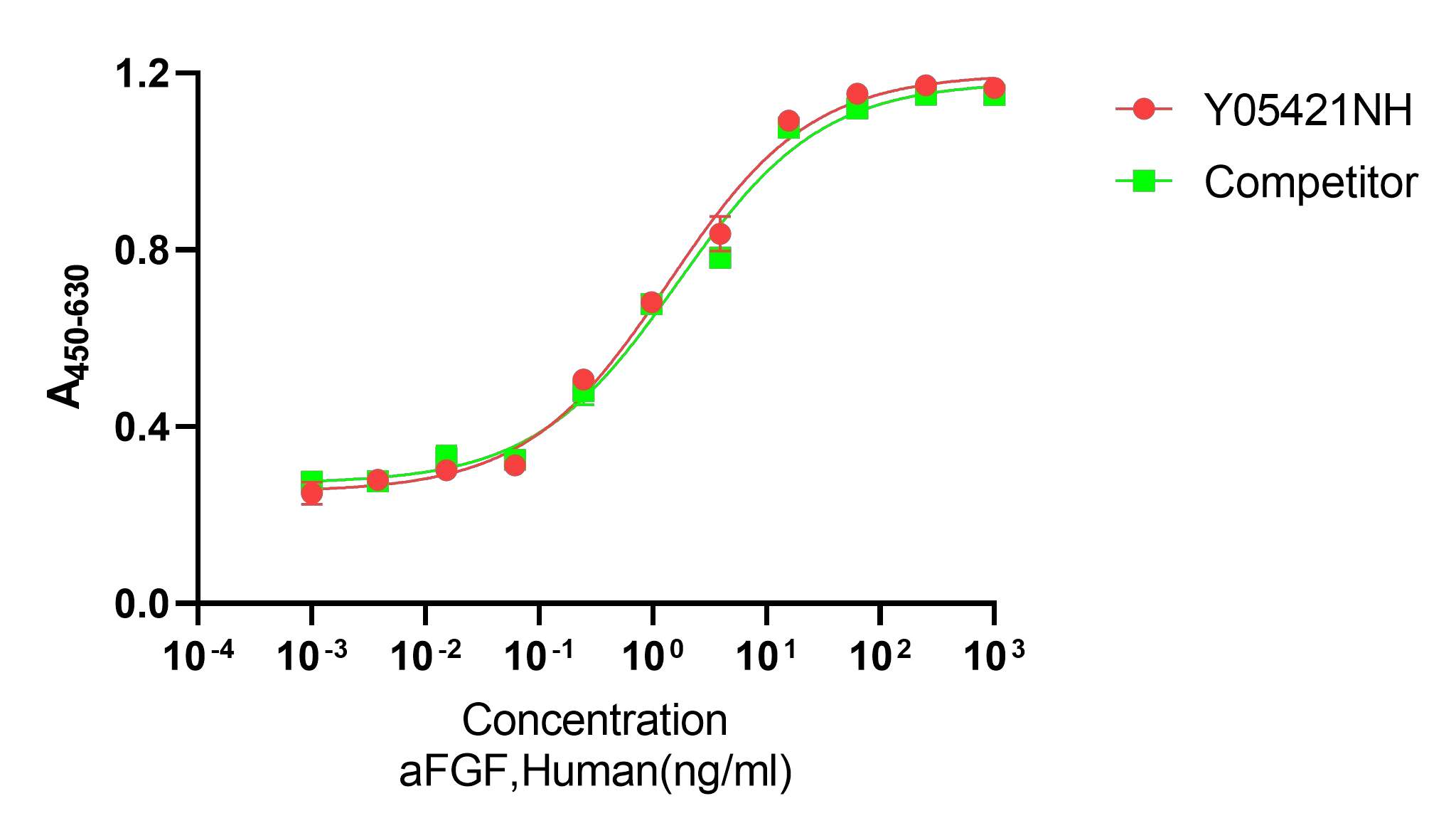
| Bioactivity | Measured in a cell proliferation assay using NIH3T3 mouse embryonic fibroblast cells. The ED50 for this effect ≤ 2.0 ng/mL. |
| Accession | NP_001127073.1 |
| Alternative Names | Fibroblast Growth Factor 1 (Acidic),HBGF1,Acidic fibroblast growth factor,Heparin-binding growth factor 1,HBGF-1,Beta,FGF-1,AFGF,FGFA,ECGF,Beta-Endothelial Cell Growth Factor,ECGF-Beta,FGF-Alpha,GLIO703,ECGFA,ECGFB |
| Species | Human |
| Expression System | E. coli |
| Mol. Weight | 15.8 kDa |
| Expression Region | Phe16 - Asp155 |
| Tag Info | Tag Free |
| Formulation | Lyophilized |
| Buffer | 20 mM Citric acid, 5% Trehalos, 0.01% Tween 80, pH 2.5 |
| Lead Time | Products are in stock, but custom products may require further consultation. |
| Shipping | The product is shipped with blue ice. |
Stability and Reconstitution
36 months at -20°C to -80°C in lyophilized state;
6 months at -20°C to -80°C under sterile conditions after reconstitution;
7-10 days at 2°C to 8°C under sterile conditions after reconstitution;
Use a manual defrost freezer and avoid repeated freeze-thaw cycles.
It is recommended to redissolve in sterile deionized water.
Backgroud
Fibroblast Growth Factor 1, also known as FGF-1, aFGF, or endothelial cell growth factor, is the founding member of the FGF family. Unlike most FGFs, FGF-1 lacks a classical signal peptide and is released through non-classical secretion pathways or from damaged cells. It binds with high affinity to all four FGF receptors (FGFR1, FGFR2, FGFR3, and FGFR4) in the presence of heparan sulfate proteoglycans, activating RAS-MAPK, PI3K-AKT, and PLCγ signaling cascades. This broad receptor specificity underlies the wide-ranging biological activities of FGF-1, which include stimulation of fibroblast proliferation, endothelial cell migration and tube formation, neural cell survival, and cardiomyocyte protection. FGF-1 is particularly valuable in cell culture applications requiring strong mitogenic stimulation without the lineage-restricted effects of more specialized growth factors. Its acidic isoelectric point distinguishes it from basic FGF-2 and influences its heparin-binding properties and tissue distribution. EastMabBio's FGF-1 is validated for endothelial cell proliferation, neural stem cell maintenance, and fibroblast growth assays, providing researchers with a reliable source of this foundational growth factor.
Q&A
Q1: What is FGF-1/aFGF mainly used for?
FGF-1/aFGF is primarily used for fibroblast and endothelial cell proliferation, neural stem cell culture, angiogenesis research, and wound healing studies.
Q2: Is this FGF-1/aFGF suitable for serum-free culture systems?
Yes. EastMabBio recombinant FGF-1/aFGF is compatible with serum-free, xeno-free, and chemically defined media systems.
Q3: How should recombinant FGF-1/aFGF be stored?
Lyophilized protein should be stored at -20°C or below. After reconstitution, aliquot and avoid repeated freeze-thaw cycles.
Q4: What shipping conditions are used?
Products are shipped on dry ice with validated cold-chain packaging to maintain stability during international transportation.
Q5: Do you provide QC documents?
Yes. COA, MSDS, TSE-BSE statements, endotoxin reports, bioactivity data, and additional QC documentation are available upon request.
Jiangsu East-Mab Bio:Building 13 and 17, 888 Zhujiang Road, Rudong, Nantong, Jiangsu 226499 , China
Suzhou East-Mab Bio:Floor 5 & 6, Building 1, 168 Majian Road, Suzhou, Jiangsu 215129, China
Platform Information Submission-Privacy Agreement
· Privacy Policy
No content yet
Platform Information Statement-Laws and Regulations
· Laws and regulations
Trademark registration of Jiangsu Dongkang Biomedical Technology Co., Ltd.
East Mab
East Mab Bio
东抗生物
 Online Consultation
 Related Products
 Application Details