
Blog
ITS Supplement for Serum-Free Cell Culture: Benefits, Functions, and Applications
2026.10.16
Recombinant Human TGF-β3 sits at the center of some of the most demanding work in cell biology and therapeutic development. It is one of those proteins where small differences in quality show up immediately in downstream results — inconsistent lots can derail months of optimization. The protein’s role in directing cell fate decisions, modulating immune responses, and supporting tissue formation makes it a recurring requirement across stem cell research, organoid culture, and cell therapy manufacturing. What follows covers the structural basis for its function, the applications where it matters most, and the production considerations that determine whether a given lot will perform reliably in sensitive workflows.
Recombinant Human TGF-β3 belongs to the TGF-β superfamily, a group of GFsthat regulate cellular behavior across nearly every tissue type. The active protein forms a homodimer — two identical polypeptide chains linked by disulfide bonds. This dimeric architecture is not incidental. It determines how the protein engages its receptors and initiates downstream signaling cascades.
The signaling mechanism involves binding to type II TGF-β receptors, which then recruit and phosphorylate type I receptors. This triggers SMAD protein activation and nuclear translocation, ultimately altering gene expression patterns. The specificity of TGF-β3 compared to its close relatives TGF-β1 and TGF-β2 comes down to subtle differences in receptor affinity and tissue distribution. TGF-β3 shows particular prominence in wound healing contexts, where it has been associated with reduced scarring compared to other isoforms.
The protein influences cell proliferation, differentiation, and extracellular matrix production. In developmental biology, it guides epithelial-mesenchymal transitions. In immunology, it modulates T-cell responses and maintains peripheral tolerance. These broad effects explain why TGF-β3 appears in protocols ranging from cardiac differentiation to cartilage tissue engineering.
Maintaining proper folding during recombinant production is essential. Misfolded protein may retain some receptor binding but often shows altered signaling kinetics or reduced potency. This is why expression system choice, refolding protocols, and purification strategies all directly impact the functional quality of the final product.
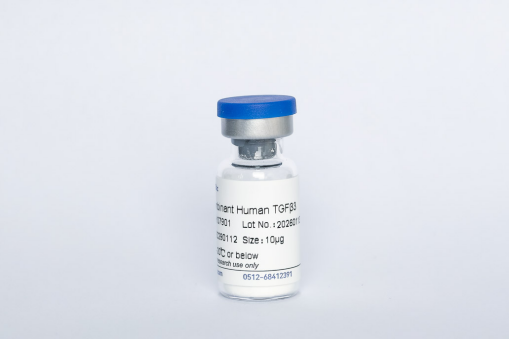
The biological activity of Recombinant Human TGF-β3 translates into practical utility across several high-value applications. Each use case places specific demands on protein quality and consistency.
In stem cell differentiation protocols, TGF-β3 helps direct pluripotent cells toward mesenchymal, chondrogenic, or cardiac lineages. The protein concentration and timing of exposure matter — too much or too little at the wrong stage can push cells toward unintended fates. Researchers working with induced pluripotent stem cells often include TGF-β3 in defined media formulations to achieve reproducible differentiation outcomes.
Organoid development represents another area where TGF-β3 plays a structural role. These three-dimensional tissue models require precise growth factor cocktails to recapitulate organ-specific architecture. TGF-β3 supports the formation of epithelial structures and influences the balance between proliferation and differentiation within the organoid.
Cell therapy manufacturing has driven demand for recombinant proteins that meet stringent quality standards. TGF-β3 appears in protocols for expanding mesenchymal stem cells while preserving their therapeutic properties. In CAR-T production, it can influence T-cell phenotype and persistence characteristics. The shift toward serum-free and animal-free media formulations has made high-quality recombinant growth factors essential rather than optional.
Application Area | Primary Role of TGF-β3 | Key Benefit |
Stem Cell Differentiation | Directs lineage commitment | Precise cellular control |
Organoid Development | Supports 3D tissue formation | Complex model fidelity |
Cell TherapyManufacturing | Enhances cell growth/viability | Improved therapeutic safety |
Tissue Engineering | Promotes matrix synthesis | Functional tissue repair |
Wound Healing | Modulates inflammation/repair | Accelerated recovery |
The gap between a TGF-β3 product that works and one that creates problems often comes down to manufacturing and quality control practices. Several parameters deserve attention when evaluating suppliers.
Purity affects both activity and safety. Contaminating proteins can introduce unwanted biological effects or trigger immune responses in sensitive applications. Host cell proteins, nucleic acids, and endotoxins all require monitoring. For cell therapy applications, endotoxin levels typically need to fall below 1 EU/μg — a threshold that requires careful attention throughout production.
Biological activity verification goes beyond simple binding assays. Functional assays that measure downstream effects, such as SMAD phosphorylation or reporter gene activation, provide more meaningful quality data. Activity should be expressed in standardized units that allow comparison across lots and suppliers.
Lot-to-lot consistency determines whether protocols developed with one batch will work with the next. This consistency depends on controlled manufacturing processes, from cell banking through final formulation. GMP-grade production principles, even for research-use products, help ensure reproducibility.
The production system itself influences protein characteristics. Mammalian expression systems typically produce TGF-β3 with native-like glycosylation, though the protein’s activity does not strictly require these modifications. Bacterial systems can produce functional protein but require careful refolding to achieve proper disulfide bond formation. The choice involves tradeoffs between cost, scalability, and product characteristics.
Animal-free production has become increasingly important for applications with regulatory implications. Eliminating animal-derived components from media and process additives reduces both safety concerns and documentation burden for downstream users.
Poor-quality TGF-β3 introduces variability that masks or mimics biological effects. If protein activity varies between lots, dose-response relationships become unreliable. Contaminating proteins can activate unintended pathways, creating confounding signals. Endotoxin contamination triggers inflammatory responses that complicate interpretation of any immune-related readout. These issues compound over time — early experiments may appear successful, but results fail to replicate when new lots arrive. For therapeutic development, inconsistent raw materials create regulatory headaches and can delay programs by months. The cost of high-quality protein is trivial compared to the cost of troubleshooting failed experiments or explaining data inconsistencies to regulators.
Sourcing recombinant proteins involves more than comparing catalog prices. Reliability, documentation, and technical support all factor into the real cost of a supplier relationship.
Research quantities and manufacturing scale present different challenges. Small-scale users need convenient packaging and reasonable minimum orders. Manufacturing operations require bulk supply with guaranteed availability and consistent lead times. The ability to scale from milligram to gram quantities without changing suppliers simplifies process development.
Documentation requirements vary by application. Academic research may need only a certificate of analysis. Cell therapy manufacturing requires detailed batch records, raw material traceability, and often supplier audits. Having this documentation available — or being able to generate it — saves time during regulatory submissions.
Technical support matters when troubleshooting unexpected results. Access to scientists who understand both the protein and its applications can resolve issues faster than trial-and-error approaches. This support becomes particularly valuable when adapting published protocols to new cell types or culture conditions.
Custom synthesis capabilities address situations where standard products do not fit. Modified proteins, alternative formulations, or specific activity specifications may be needed for particular applications. Suppliers with flexible manufacturing platforms can accommodate these requirements.
EastMabBio provides Recombinant Human TGF-β3 with the quality parameters and supply flexibility that demanding applications require. Our production platform delivers consistent, high-purity protein suitable for both research and manufacturing use.
Jiangsu East-Mab Biomedical Technology Co., Ltd. produces Recombinant Human TGF-β3 using a validated manufacturing platform designed for consistency and purity. The protein is suitable for sensitive applications including cell therapy development and IVD manufacturing, with verified biological activity and controlled endotoxin levels. Technical support is available to help match product specifications to application requirements. Supply options range from research quantities to bulk manufacturing scale, with documentation appropriate for regulated applications.
Jiangsu East-Mab Biomedical Technology Co., Ltd. offers Recombinant Human TGF-β3 produced under rigorous quality standards. Our manufacturing platform supports applications from early research through commercial cell therapy production. Technical teams are available to discuss specific requirements and help identify the right product specifications for your work.
Contact us at +86-400-998-0106 or product@eastmab.com to discuss your TGF-β3 requirements.
Recombinant Human TGF-β3 is a cytokine that regulates cell growth, differentiation, and immune responses through receptor-mediated signaling. It binds to cell surface receptors and activates SMAD-dependent pathways that alter gene expression. The protein is particularly associated with extracellular matrix production, tissue repair processes, and modulation of inflammatory responses. Its effects vary by cell type and context — it can promote or inhibit proliferation depending on the target cell population and presence of other signals.
Production uses validated expression systems and purification processes designed for consistency. Each lot undergoes testing for purity by SDS-PAGE and HPLC, endotoxin levels by LAL assay, and biological activity using cell-based functional assays. Specifications are set based on application requirements, with tighter limits for cell therapy applications. Batch records and certificates of analysis document results for each lot. The manufacturing process follows GMP principles to ensure reproducibility across production campaigns.
EastMabBio produces Recombinant Human TGF-β3 using animal-free manufacturing processes. No animal-derived components are used in the expression system, purification process, or final formulation. This makes the protein suitable for serum-free and animal-free media formulations used in cell therapy manufacturing and other regulated applications. Documentation confirming animal-free status is available for regulatory submissions.
Packaging options range from microgram quantities for initial research work to gram-scale bulk supply for manufacturing applications. Standard lyophilized formats provide stability during shipping and storage. Custom formulations, including specific buffer compositions or liquid formats, can be arranged for manufacturing applications with particular requirements. Lead times and minimum order quantities vary by scale — contact technical support to discuss specific needs and confirm availability.
News
Platform Information Submission-Privacy Agreement
· Privacy Policy
No content yet
Platform Information Statement-Laws and Regulations
· Laws and regulations
Trademark registration of Jiangsu Dongkang Biomedical Technology Co., Ltd.
East Mab
East Mab Bio
东抗生物


