
Blog
Unlocking Stem Cell Potential: A Guide to Culture-Related Proteins
2026.02.13
As the fields of stem cell research, regenerative medicine, and cell therapy continue to evolve, the demand for high-quality cytokines has increased significantly. Among these cytokines, Thrombopoietin (TPO) has emerged as one of the most important growth factors for hematopoietic stem cell maintenance, megakaryocyte differentiation, and ex vivo cell expansion.
Recombinant Human TPO Protein has become an indispensable component in modern serum-free and chemically defined cell culture systems, supporting applications ranging from basic hematology research to advanced cell and gene therapy manufacturing.
Thrombopoietin, commonly referred to as TPO, is a glycoprotein cytokine primarily produced by the liver and kidneys. It serves as the principal physiological regulator of platelet production in the body.
TPO exerts its biological activity by binding to the c-Mpl receptor (also known as CD110), which is expressed on hematopoietic stem cells (HSCs), progenitor cells, megakaryocytes, and platelets. Upon receptor binding, TPO activates multiple intracellular signaling pathways, including JAK/STAT, PI3K/AKT, and MAPK pathways, ultimately regulating cell survival, proliferation, self-renewal, and differentiation.
Because of its essential role in hematopoiesis, recombinant TPO protein has become widely used in stem cell culture and cell manufacturing workflows.
1. Maintenance and Expansion of Hematopoietic Stem Cells
One of the most important functions of TPO is the maintenance of hematopoietic stem cell self-renewal.
Numerous studies have demonstrated that TPO supports the survival and expansion of primitive CD34+ hematopoietic stem and progenitor cells while preserving their long-term repopulating capacity. In combination with cytokines such as Stem Cell Factor (SCF), FLT3 Ligand (FLT3L), and Interleukin-3 (IL-3), TPO significantly enhances ex vivo HSC expansion.
This property makes recombinant TPO indispensable for:
Hematopoietic stem cell research
Cord blood expansion
Bone marrow stem cell culture
Gene editing workflows
Cell therapy process development
2. Megakaryocyte Differentiation
Megakaryocytes are specialized bone marrow cells responsible for platelet production. TPO is recognized as the most potent cytokine promoting megakaryocyte proliferation, maturation, and polyploidization.
In vitro differentiation protocols frequently utilize TPO to drive CD34+ cells, induced pluripotent stem cells (iPSCs), or embryonic stem cells toward the megakaryocyte lineage.
The ability to efficiently generate megakaryocytes has become increasingly important for:
Platelet production research
Disease modeling
Drug screening
Transfusion medicine
Regenerative medicine applications
3. Platelet Production and Manufacturing
With growing interest in laboratory-generated platelets as alternatives to donor-derived platelet transfusions, recombinant TPO has become a key component in scalable platelet manufacturing platforms.
Researchers have shown that optimized culture systems containing TPO can substantially improve platelet yield and functionality, facilitating the development of next-generation platelet therapies.
1. Hematopoietic Stem Cell Expansion
TPO is routinely incorporated into serum-free media formulations designed for ex vivo expansion of CD34+ hematopoietic stem cells. Typical cytokine combinations include TPO + SCF + FLT3L, TPO + SCF + IL-6 and TPO + SCF + IL-3, these combinations support robust cell proliferation while maintaining stemness.
2. Cell and Gene Therapy
The rapid expansion of cell and gene therapy has increased demand for high-quality recombinant cytokines manufactured under stringent quality standards. TPO is widely utilized in:
CAR-T cell manufacturing support processes
Gene-edited HSC expansion
Hematopoietic stem cell transplantation research
Genome engineering workflows
GMP process development
Consistent cytokine quality is critical for ensuring reproducible manufacturing outcomes and minimizing process variability.
3. iPSC and ESC Differentiation
Induced pluripotent stem cells have become valuable tools for disease modeling and regenerative medicine. During differentiation toward hematopoietic or megakaryocytic lineages, TPO plays a central role in promoting lineage commitment and maturation.
Many published differentiation protocols employ TPO alongside SCF, BMP-4, VEGF, and FLT3L to generate hematopoietic progenitors and functional megakaryocytes.
4. Organoid and Bone Marrow Niche Research
Advanced three-dimensional culture systems and organoid technologies increasingly rely on defined cytokine combinations to recapitulate the bone marrow microenvironment.
TPO contributes to maintaining hematopoietic progenitors within engineered bone marrow niche models, enabling more physiologically relevant studies of hematopoiesis, leukemia, and drug responses.
The success of stem cell and cell therapy workflows depends heavily on cytokine quality. Variability in protein purity, endotoxin content, or biological activity may significantly affect experimental outcomes.
When selecting a recombinant TPO supplier, researchers should consider several key attributes:
High Biological Activity: Potent biological activity ensures efficient receptor activation and robust cellular responses, reducing the amount of cytokine required in culture.
High Purity: High-purity proteins minimize unwanted contaminants that could interfere with cell growth or downstream analyses.
Low Endotoxin Levels: Endotoxin contamination can adversely affect sensitive primary cells and stem cells, leading to altered cellular behavior or reduced viability.
Batch-to-Batch Consistency: Reliable lot-to-lot consistency is essential for reproducible research, process standardization, and large-scale manufacturing.
Scalability: As projects progress from discovery to clinical translation, scalable manufacturing capabilities become increasingly important.
Produced under rigorous quality control standards, EastMabBio Recombinant Human TPO Protein is designed to support demanding applications in stem cell research and advanced biomanufacturing.
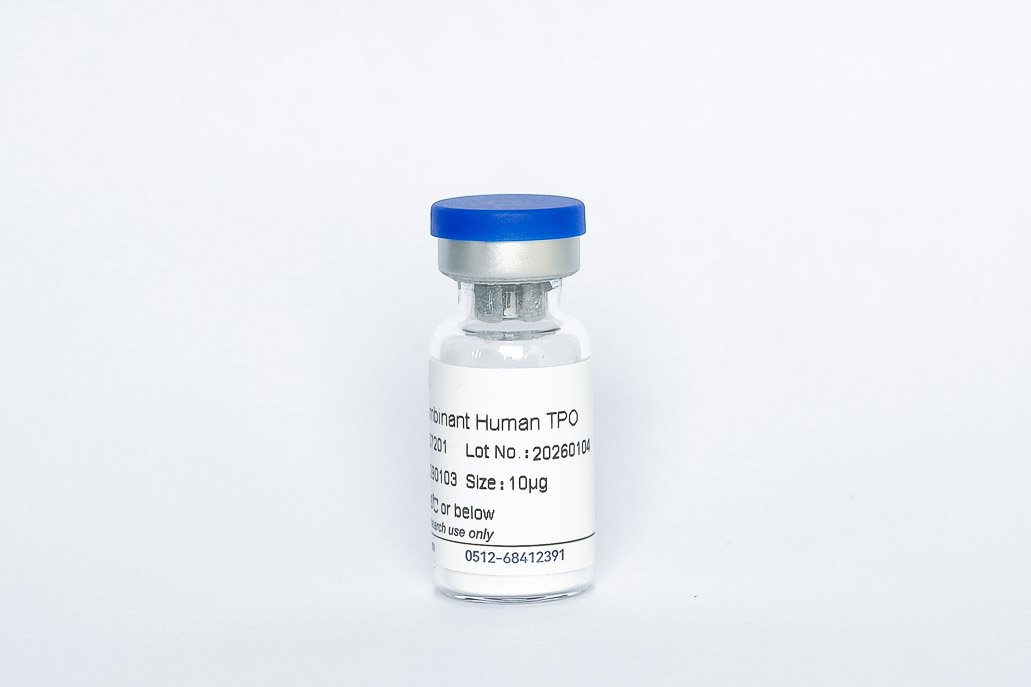
Key advantages include:
High purity: ≥95% as verified by SDS-PAGE and HPLC
Low endotoxin: ≤10 EU/mg, ideal for sensitive cell culture applications
Excellent batch-to-batch consistency: Stable performance guaranteed across production runs
Reliable biological activity: Confirmed via cell proliferation assay using Mo7e human leukemia cells, with an ED50 ≤1.0 ng/mL
Strong supply capacity: Supported by a 4,000 m² GMP-compliant workshop, capable of meeting both research and large-scale manufacturing demands
By providing high-quality recombinant cytokines, EastMabBio aims to support researchers and biopharmaceutical companies in accelerating innovation across stem cell biology, regenerative medicine, and cell therapy development.
As the next generation of advanced therapies continues to expand, recombinant TPO protein will remain a cornerstone cytokine for hematopoietic stem cell expansion, megakaryocyte differentiation, and scalable cell manufacturing.
For scientists seeking consistent and reliable cytokine solutions, high-quality recombinant human TPO protein represents a critical investment in experimental success and translational progress.
Platform Information Submission-Privacy Agreement
· Privacy Policy
No content yet
Platform Information Statement-Laws and Regulations
· Laws and regulations
Trademark registration of Jiangsu Dongkang Biomedical Technology Co., Ltd.
East Mab
East Mab Bio
东抗生物