
Promotions
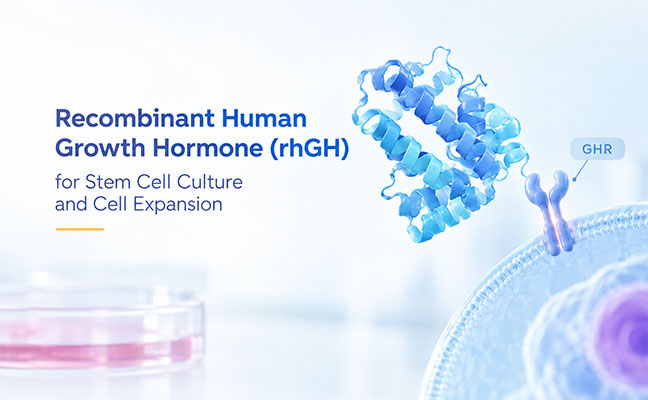
Recombinant Human Growth Hormone (rhGH) for Stem Cell Culture and Cell Expansion
2026.09.20
With the rapid advancement of cell and gene therapy (CGT), organoid research, induced pluripotent stem cells (iPSCs), regenerative medicine, and cultivated meat, traditional cell culture systems that rely on fetal bovine serum (FBS) are increasingly being replaced by serum-free media (SFM).
Compared with serum-containing media, serum-free cell culture media offer several significant advantages, including defined composition, reduced risk of animal-derived contamination, improved batch-to-batch consistency, enhanced experimental reproducibility, and greater compatibility with GMP manufacturing, regulatory compliance, large-scale bioprocessing, and automated production.
However, eliminating serum does not reduce the nutritional requirements of cultured cells. Instead, researchers must precisely supplement serum-free media with high-quality recombinant proteins, growth factors, cytokines, and extracellular matrix (ECM) proteins to provide essential nutrients, signaling molecules, and microenvironmental support for optimal cell growth.
So, what are the key recombinant proteins commonly used in a mature serum-free cell culture system?
Insulin is one of the most fundamental functional proteins in serum-free media. By binding to insulin receptors on the cell surface, it activates signaling pathways such as PI3K/AKT and MAPK, promoting glucose uptake, amino acid transport, and protein synthesis. These activities provide cells with sufficient energy and nutrients while enhancing cell proliferation and reducing apoptosis. As a result, insulin plays an essential role in maintaining normal cellular metabolism and viability.
Transferrin is the primary iron transport protein in cell culture media, responsible for delivering ferric ions (Fe³⁺) safely and efficiently into cells. Iron is indispensable for DNA synthesis, mitochondrial respiration, and cell proliferation.
Compared with directly adding iron salts, transferrin minimizes oxidative stress and cytotoxicity caused by free iron, making it a critical component of serum-free and chemically defined media.
Albumin serves as a multifunctional carrier protein within cell culture media. It transports fatty acids, cholesterol, vitamins, hormones, and various small molecules while stabilizing sensitive media components.
In addition, albumin exhibits antioxidant properties by scavenging reactive oxygen species, helping create a more stable microenvironment that supports long-term cell culture and improves overall cell performance.
Epidermal Growth Factor (EGF) is one of the most widely used growth factors in serum-free cell culture.
After binding to the EGF receptor (EGFR), EGF activates the MAPK/ERK and PI3K/AKT signaling pathways, promoting cell proliferation, migration, and survival.
EGF is extensively used in the culture of epithelial cells, stem cells, and organoids. It is particularly essential for maintaining the growth and self-renewal of intestinal, gastric, lung, and skin organoids.
To maximize culture performance, EGF is frequently combined with bFGF, HGF, IGF-I, Wnt3a, and R-Spondin 1 to establish robust serum-free culture systems.
IGF-I is another key growth factor widely incorporated into serum-free media.
By activating the PI3K/AKT and MAPK signaling pathways, IGF-I promotes cell proliferation, enhances cell survival, and effectively suppresses apoptosis.
It is commonly used in stem cell culture, cell therapy, biopharmaceutical manufacturing, regenerative medicine, and cultivated meat production, often working synergistically with Insulin and bFGF to provide sustained growth signals.
Basic Fibroblast Growth Factor (bFGF or FGF2) is one of the most important recombinant growth factors used in embryonic stem cell (ESC), induced pluripotent stem cell (iPSC), and mesenchymal stem cell (MSC) culture.
It promotes cell proliferation, maintains pluripotency, enhances self-renewal, and significantly improves cell expansion efficiency while preserving the undifferentiated state of stem cells.
Hepatocyte Growth Factor (HGF) exerts its biological functions through activation of the c-MET receptor, stimulating cell proliferation, migration, survival, and tissue regeneration.
Today, HGF is widely applied in the culture of liver, lung, and kidney organoids, as well as in regenerative medicine, cell therapy, and tissue engineering research.
Extracellular Matrix (ECM) proteins provide much more than structural support.
They regulate cell adhesion, migration, proliferation, differentiation, and tissue organization, making them indispensable for advanced cell culture systems.
With the increasing adoption of serum-free media and 3D cell culture, recombinant ECM proteins—including Fibronectin, Laminin, and Vitronectin—are rapidly replacing animal-derived matrices by providing standardized, defined, and highly reproducible cell culture substrates.
As cell culture technologies continue to move toward industrial-scale manufacturing, protein components must satisfy not only biological performance but also stringent requirements for quality consistency, supply stability, regulatory compliance, and scalability.
Compared with naturally derived proteins, recombinant proteins offer numerous advantages, including:
Animal-origin free production
High batch-to-batch consistency
High purity and low impurity levels
Reduced contamination risk
Compatibility with GMP manufacturing
Excellent scalability for commercial production
Improved reproducibility in research and manufacturing
For these reasons, recombinant proteins have become the preferred choice for developing standardized serum-free media used in cell therapy, organoid culture, biopharmaceutical production, regenerative medicine, and cultivated meat manufacturing.
EastMabBio specializes in the research, development, and manufacturing of high-quality recombinant proteins for both research and industrial applications.
We provide a comprehensive portfolio of key components for serum-free media, including:
Recombinant Human and Bovine Insulin
Recombinant Human and Bovine Transferrin
EGF, FGF, IGF, and TGF-β growth factors
Organoid culture proteins such as Wnt3a, R-Spondin 1, and Noggin
Recombinant ECM proteins including Fibronectin, Laminin, and Vitronectin
Our recombinant proteins are manufactured with high purity, low endotoxin levels, excellent batch-to-batch consistency, and controlled animal-origin content, providing reliable solutions for cell therapy, organoid research, stem cell culture, biopharmaceutical manufacturing, regenerative medicine, and cultivated meat production.
By combining advanced recombinant protein technologies with rigorous quality management, EastMabBio is committed to helping researchers and manufacturers build high-performance, standardized, and scalable serum-free cell culture systems that accelerate scientific innovation and industrial commercialization.
| Endotoxin (EU/mg) | Expression System | ||||
|---|---|---|---|---|---|
Y00801 | Human | ≥95% | ≤10 | CHO | |
Y00351H | Human | ≥95% | ≤20 | E.coli | |
Y03501 | R-Spondin-1 | Human | ≥95% | ≤10 | CHO |
Y03301 | Noggin | Human | ≥95% | ≤10 | CHO |
Y04603 | Wnt-3a | Human | ≥95% | ≤10 | CHO |
Y03101 | LR3 IGF-I | Human | ≥95% | ≤10 | CHO |
| Y04501 | Transferrin | Human | ≥95% | ≤0.5 | CHO |
Y04542 | Transferrin | Bovine | ≥95% | ≤10 | CHO |
Y10001 | Insulin | Human | ≥95% | ≤20 | Yeast |
Y13011B | Insulin | Bovine | ≥95% | ≤10 | Yeast |
Y12901B | Albumin | Bovine | ≥95% | ≤10 | CHO |
≤10 | |||||
≥95% | ≤10 | ||||
| Y13242H | ≥95% | ≤10 |
News
Platform Information Submission-Privacy Agreement
· Privacy Policy
No content yet
Platform Information Statement-Laws and Regulations
· Laws and regulations
Trademark registration of Jiangsu Dongkang Biomedical Technology Co., Ltd.
East Mab
East Mab Bio
东抗生物


