
Promotions
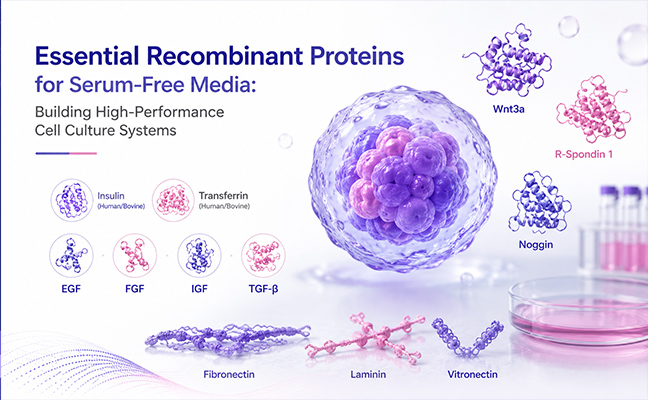
Essential Recombinant Proteins for Serum-Free Media: Building High-Performance Cell Culture Systems
2026.07.21
As organoid research, stem cell biology, tissue engineering, regenerative medicine, and cell therapy continue to advance, researchers are moving beyond conventional two-dimensional (2D) cell culture toward increasingly sophisticated three-dimensional (3D) culture and tissue engineering systems.
As cells transition from simply maintaining viability to achieving functional growth and differentiation, one critical challenge has become increasingly apparent: How can researchers provide cells with growth signals that more closely resemble their native microenvironment?
Vascular endothelial growth factor (VEGF) has become an important research tool for studying angiogenesis, tissue repair, and the cellular microenvironment. Among the various VEGF isoforms, Recombinant Human VEGF165 is one of the most widely used and extensively studied forms.
The VEGF family consists of multiple isoforms, with VEGF165 being one of the most extensively studied and widely used members.
VEGF165 interacts with receptors including VEGFR-1 and VEGFR-2 and plays an important role in regulating endothelial cell proliferation, migration, and angiogenesis.
In simplified terms:
VEGF165 → VEGFR signaling → Endothelial cell activation → Angiogenesis
Therefore, supplementing VEGF165 in vitro can provide cells with critical pro-angiogenic signals required for endothelial cell growth and vascular formation.
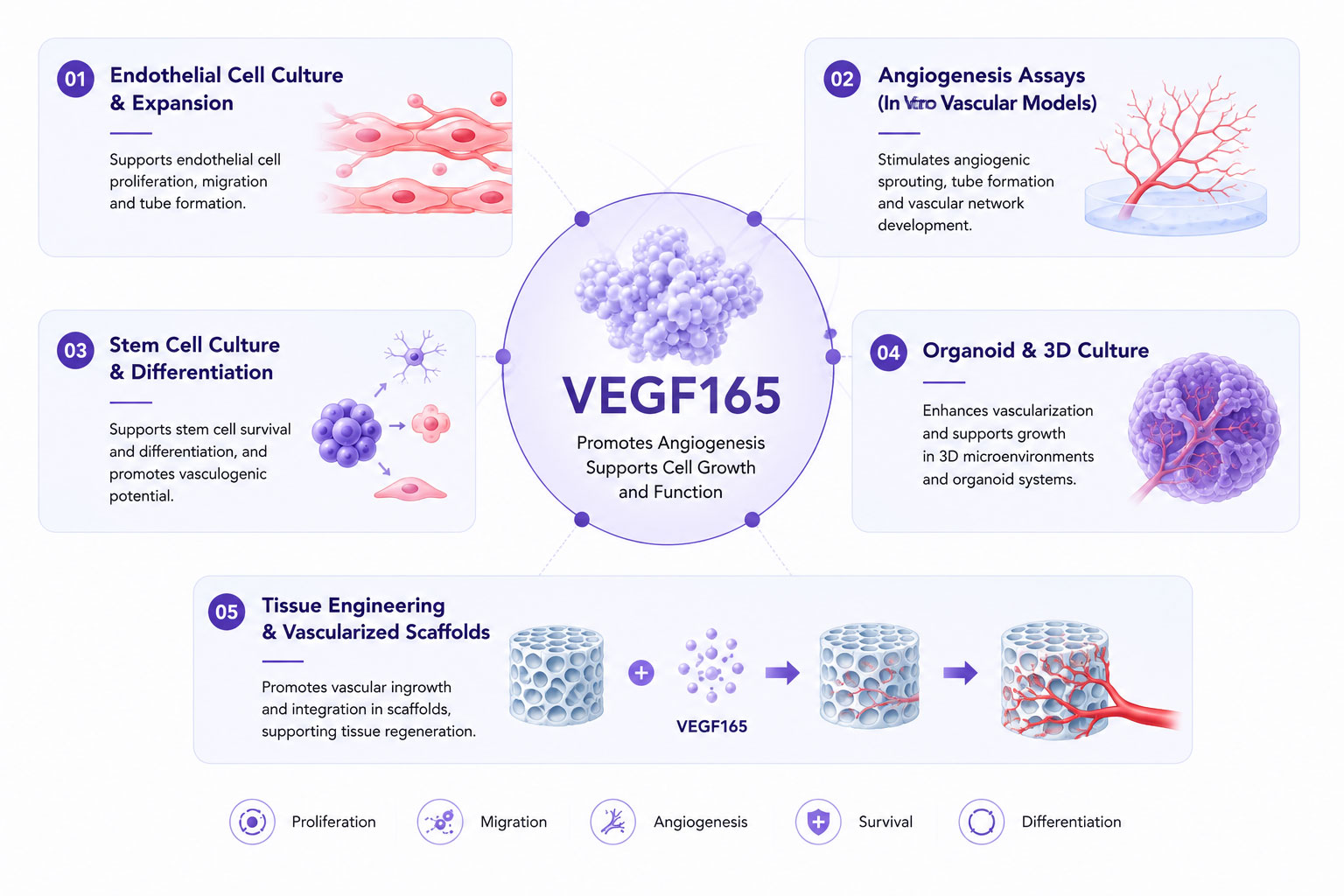
Today, VEGF165 is widely used in:
· Vascular endothelial cell culture and expansion
· Angiogenic functional assays, including in vitro tube formation models
· Stem cell culture and differentiation
· Organoid and 3D cell culture
· Tissue engineering and vascularized scaffold development
01 — Vascular Endothelial Cell Culture & Expansion
Supports the proliferation and expansion of vascular endothelial cells.
02 — Angiogenic Functional Assays
Provides a key pro-angiogenic signal for in vitro angiogenesis and tube formation studies.
03 — Stem Cell Culture & Differentiation
Used as a growth and differentiation factor in stem cell research.
04 — Organoid & 3D Culture
Supports the development of more physiologically relevant 3D cellular microenvironments.
05 — Tissue Engineering & Vascularized Scaffolds
Contributes to angiogenic signaling in tissue engineering and vascularization-related research.
Key biological activities illustrated in the figure:
Proliferation · Migration · Angiogenesis · Survival · Differentiation
VEGF165 has long been associated with three major challenges in cell culture and angiogenesis-related research.
Angiogenesis assays—including tube formation, scratch wound healing, and Transwell migration assays—are highly dependent on VEGF biological activity.
Variations in activity between production lots can directly affect experimental outcomes, making results less reproducible and reducing comparability across experiments.
Endotoxin is an often-overlooked factor that can compromise cell culture quality.
High levels of endotoxin in recombinant proteins may activate immune cells, interfere with experimental results, and, in some cases, adversely affect cell viability.
For long-term culture of primary endothelial cells such as HUVECs, low endotoxin levels are an essential quality requirement.
The high cost of commercially available growth factors can place considerable pressure on research budgets.
This becomes particularly important for studies involving large-scale screening, repeated experiments, or long-term cell culture, where growth factor consumption can significantly increase overall experimental costs.
With numerous recombinant VEGF165 products available on the market, researchers should evaluate products across multiple quality dimensions.
Among these parameters, lot-to-lot consistency is one of the most easily overlooked yet critical factors. It directly affects the comparability and reproducibility of experiments performed at different times or using different production lots.
Key Evaluation Criteria for Recombinant VEGF165
| Evaluation Parameter | Key Criteria |
| Purity | SDS-PAGE ≥95%; SEC-HPLC verified |
| Biological Activity | ED50 value validated in HUVEC proliferation assays |
| Endotoxin | ≤0.01 EU/μg |
| Lot-to-Lot Consistency | Comparable ED50 values across multiple lots |
| Expression System | CHO mammalian expression system for native-like protein folding and post-translational modifications |
| Manufacturing System | Manufactured under an ISO 13485 quality management system and GMP-compliant production framework |
To address the needs of cell culture, angiogenesis research, and tissue engineering, EastMabBio provides high-quality Recombinant Human VEGF165 designed to offer researchers a stable and well-controlled source of growth factor.
Our Recombinant Human VEGF165 is produced using a CHO mammalian expression system, supporting appropriate protein folding and post-translational modifications and providing a molecular conformation and functional profile closer to the native protein.
The product is characterized by both SDS-PAGE and SEC-HPLC, with a purity of ≥95%.
Endotoxin level is controlled at ≤0.01 EU/μg, helping support the reliable culture and experimental use of sensitive primary endothelial cells.
Biological activity is validated using a HUVEC proliferation assay, with an ED50 of 0.2–5 ng/mL.
The product is manufactured, tested, and released under an ISO 13485 quality management system and GMP-compliant framework, with quality controls designed to maintain consistent purity, biological activity, and low endotoxin levels across production lots.
The product is supplied in a lyophilized format, facilitating long-term storage and convenient reconstitution according to experimental requirements.
In angiogenesis research, reliable research tools are essential for generating reliable results.
With its combination of mammalian expression, high purity, ultra-low endotoxin, strong biological activity, and lot-to-lot consistency, EastMab Bio Recombinant Human VEGF165 is designed to support researchers in generating reproducible and reliable experimental data—from a dependable starting point.
Quality Data for Recombinant Human VEGF165
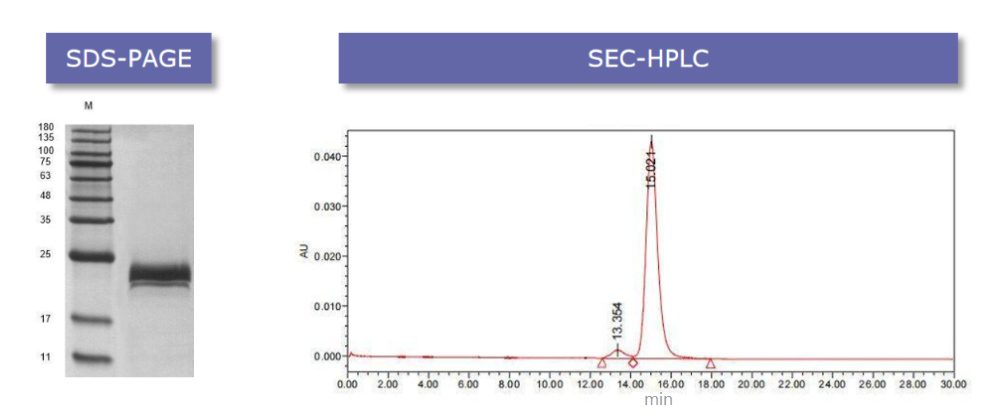
VEGF165 (Catalog No.: Y04701) has a purity of ≥95%, verified by SDS-PAGE and SEC-HPLC.
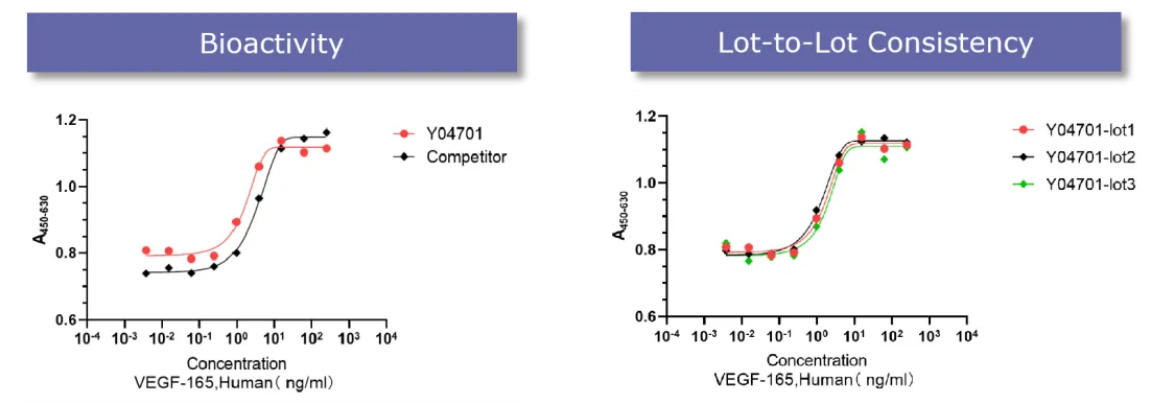
The ED₅₀ of VEGF165 (Catalog No.: Y04701) for this effect, determined by cell proliferation assays using human umbilical vein endothelial cells (HUVEC), was 0.2–5 ng/mL, with consistent activity across batches.
At EastMabBio, quality control extends beyond a single specification. We focus on an integrated quality control strategy covering purity, biological activity, endotoxin levels, and lot-to-lot consistency.
EastMabBio continues to expand its recombinant protein portfolio to support applications in cell culture, stem cell research, organoid culture, and advanced cell therapy.
Our portfolio includes a range of products such as:
· Transferrin
· Insulin
· Cytokines
· Growth Factors
· Extracellular Matrix (ECM) Proteins
From recombinant protein raw materials to advanced cell culture applications, EastMab Bio is committed to providing reliable tools that help researchers build more reproducible and controllable experimental systems.
Platform Information Submission-Privacy Agreement
· Privacy Policy
No content yet
Platform Information Statement-Laws and Regulations
· Laws and regulations
Trademark registration of Jiangsu Dongkang Biomedical Technology Co., Ltd.
East Mab
East Mab Bio
东抗生物