
Blog
Gastric Organoids: Advancing Stomach Disease Research
2026.05.07
Fibronectin (FN), Laminin 511 E8 (LN511E8), Laminin 521 E8 (LN521E8)… With different types of extracellular matrix (ECM) proteins, product specifications, and catalog numbers available, how do you choose the right one for your application?
The wrong choice may affect cell attachment efficiency, colony morphology, and proliferation, potentially increasing the time and cost required for culture system optimization.
In this article, we'll help you make the right choice by exploring four key aspects: matrix types, functional characteristics, application scenarios, and product selection.
Understanding the Differences Between Cell Adhesion Matrices
Fibronectin (FN) is an adhesive glycoprotein widely found in the extracellular matrix and blood plasma. It promotes cell adhesion, spreading, and migration through interactions with cell surface receptors, including integrins.
Applications: Mesenchymal stem cells (MSCs), fibroblasts, endothelial cells, and other anchorage-dependent cell cultures.
Laminin is a major component of the basement membrane and plays important roles in cell adhesion, polarity, differentiation, and tissue organization.
LN511E8 is the E8 fragment of Laminin-511, featuring strong cell adhesion activity and is widely used in human pluripotent stem cell culture.
Applications: hiPSCs, hESCs, neural stem cells, and related culture systems.
LN521E8 is the E8 fragment of Laminin-521. Laminin-521 is one of the important basement membrane components found in the native microenvironment of human pluripotent stem cells.
LN521E8 is commonly used in feeder-free pluripotent stem cell culture, providing reliable adhesion support for cell maintenance and expansion.
Applications: hiPSCs, hESCs, and long-term neural stem cell culture and expansion.
How to Choose Between FN, LN511E8, and LN521E8?
Matrix Type | Product Catalog No. | Expression System | Product Features | Main Applications |
|---|---|---|---|---|
FN | Y013102H | CHO | Improved batch-to-batch consistency. No pre-coating required; can be directly added to the culture medium. | MSCs, fibroblasts, endothelial cells, etc. |
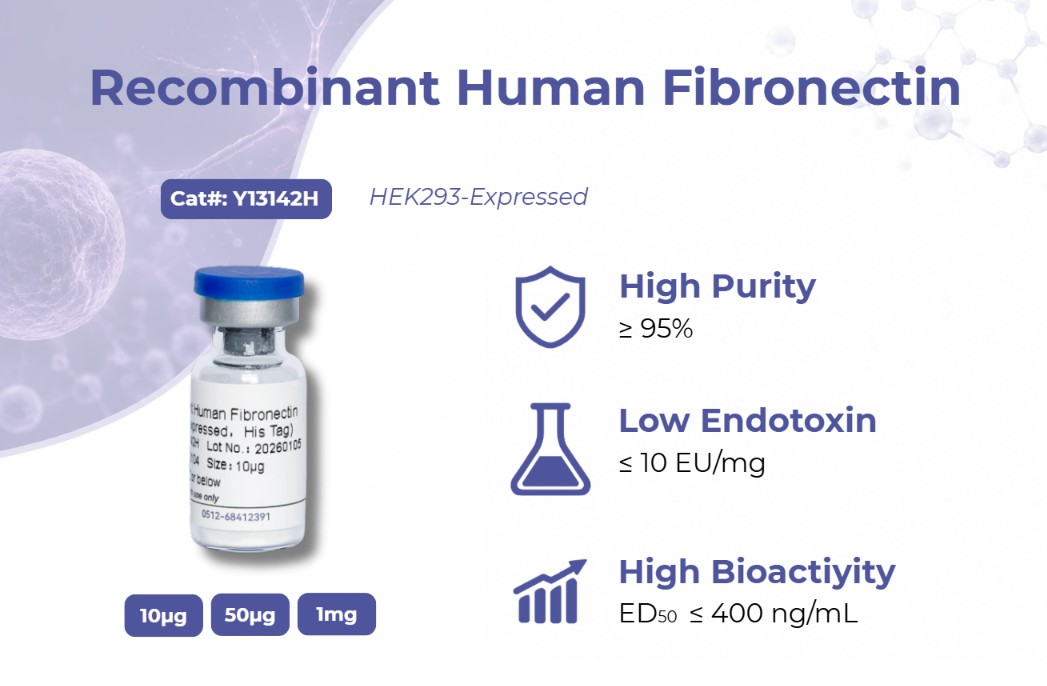
Y013142H | HEK293 | No pre-coating required; can be directly added to the culture medium. | ||
Y01344 | HEK293 | Classic coating formulation, suitable for pre-coating culture surfaces. | ||
Y01344L | HEK293 | Liquid formulation of Y01344 for convenient handling and application. | ||
LN511E8 | Y13242H | HEK293 | Coating formulation, suitable for pre-coating culture surfaces. | Neural cells, MSCs, iPSCs/ESCs, and epithelial cells |
Y13242HL | HEK293 | Liquid formulation of Y13242H for convenient handling and application. | ||
LN521E8 | Y13342H | HEK293 | No pre-coating required. Supports single-cell passaging and subsequent expansion of pluripotent stem cells. | Neural cells, MSCs, iPSCs/ESCs, and epithelial cells |
Y13342HL | HEK293 | Liquid formulation of Y13342H for convenient handling and application. |
Table 1. Cell Adhesion Matrix Product Selection Guide
Key Factors to Consider When Selecting a Cell Adhesion Matrix
Pay attention to protein purity, biological activity, structural integrity, and batch-to-batch consistency to ensure reliable and reproducible cell culture performance.
Different products may require different preparation and application methods. For example, some Fibronectin products can be added directly to the culture medium, whereas Vitronectin typically requires surface coating.
Always follow the product-specific instructions for optimal results.
Initial attachment efficiency is only one part of the evaluation. Cell morphology, proliferation rate, passaging stability, and the expression of relevant cell markers should also be considered.
The selected matrix should be compatible with your culture medium, cell type, and manufacturing process. Small-scale comparative experiments are recommended to identify the most suitable option.
Platform Information Submission-Privacy Agreement
· Privacy Policy
No content yet
Platform Information Statement-Laws and Regulations
· Laws and regulations
Trademark registration of Jiangsu Dongkang Biomedical Technology Co., Ltd.
East Mab
East Mab Bio
东抗生物