
Blog
Recombinant Proteins for Cultivated Meat: Accelerating Animal-Free Cell Culture with Food Industry-Ready Solutions
2026.07.08
The cultivated meat industry is at a pivotal moment. As production scales from laboratory benches to commercial bioreactors, one challenge remains paramount: developing cost-effective, serum-free, and chemically defined culture media that can support the rapid proliferation of muscle satellite cells (MuSCs). Growth factors alone can account for over 90% of total medium costs, making their optimization critical for the economic viability of cultivated meat.
Among these growth factors, Fibroblast Growth Factor 2 (FGF-2, also known as basic FGF or bFGF) stands out as an essential mitogen for cell proliferation, migration, and survival. But here's the key insight that many in the industry are beginning to recognize: species-specific FGF-2—derived from the same species as the target cells—offers superior performance compared to cross-species alternatives.
This is where recombinant fish FGF-2 (eel, salmon, tuna, and general fish) enters the picture as a game-changer for the cultivated seafood sector.
Why FGF-2 is Indispensable for Cell Culture
FGF-2 is a heparin-binding growth factor that plays a critical role in:
· Promoting MuSC proliferation in serum-free media
· Activating key signaling pathways including ERK and p38
· Maintaining stemness and preventing premature differentiation
· Supporting long-term expansion without losing myogenic potential
In serum-free formulations, FGF-2 is typically combined with other supplements such as fetuin and Insulin–Transferrin–Selenium (ITS) to achieve optimal cell growth. Research has demonstrated that FGF-2 supplementation in serum-free medium can achieve higher proliferation rates than serum-containing media.
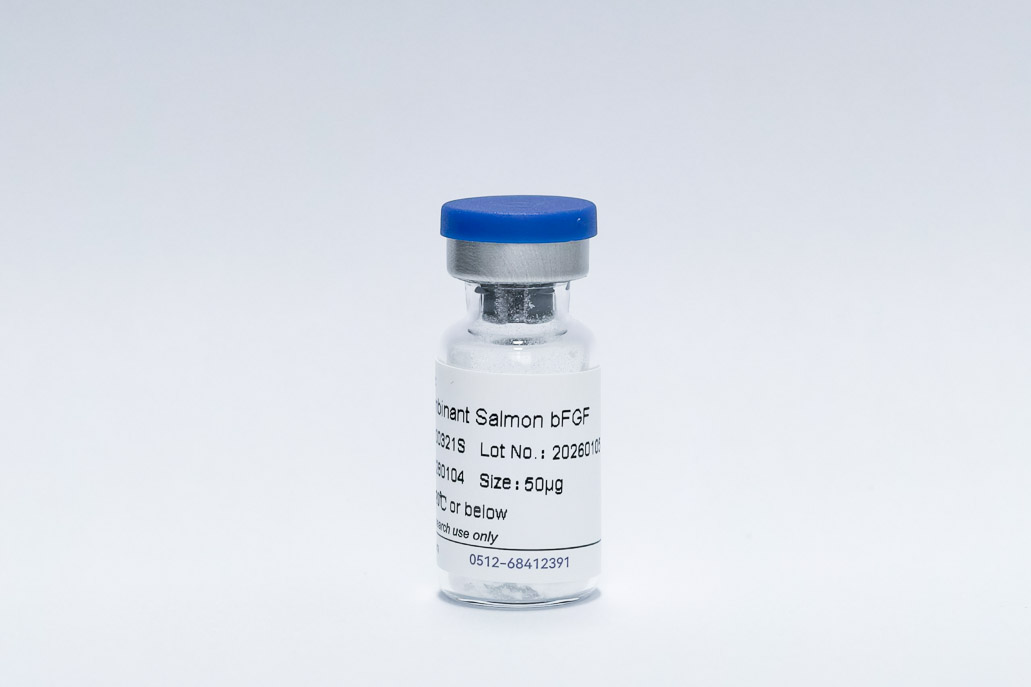
The Species-Specific Advantage:Why Fish FGF-2 Matters
Traditional cell culture has relied heavily on human or bovine FGF-2 for a wide range of applications. However, for cultivated seafood production—where the target cells are derived from fish species—this cross-species approach has significant limitations.
Receptor binding affinity and efficacy differ depending on each species. Using a species-specific growth factor enhances receptor binding affinity, resulting in a lower concentration required in culture. This translates directly to:
· Lower growth factor consumption per batch
· Reduced media costs
· More efficient cell proliferation
· Better overall process economics
The research published in npj Science of Food confirmed that recombinant FGF-2 variants from different species show varying efficacy. While bovine FGF-2 performed well at low concentrations (2 ng/mL), salmon and cod FGF-2 required higher concentrations (17.5–70 ng/mL) to achieve the same effect. This underscores the importance of optimizing FGF-2 sourcing and application strategies for each specific production system.
EastMabBio Recombinant Fish FGF-2 Product Line
EastMabBio offers a comprehensive portfolio of recombinant fish FGF-2 proteins specifically developed for cultivated seafood and cellular agriculture applications. All products are animal-origin-free (AOF) and produced in E. coli expression systems with tag-free formats, ensuring native biological activity and regulatory readiness.
| Product | Catalog No. | Species | Expression System | Purity | Endotoxin |
|---|---|---|---|---|---|
| Recombinant Fish bFGF | Y00341 | Fish (general) | E. coli | ≥95% | ≤10 EU/mg |
| Recombinant Eel bFGF | Y00321E | Eel | E. coli | ≥95% | ≤10 EU/mg |
| Recombinant Tuna FGF-2 | Y00321T | Tuna | E. coli | ≥95% | ≤10 EU/mg |
| Recombinant Salmon FGF-2 | Y00321S | Salmon | E. coli | ≥95% | ≤10 EU/mg |
Key Advantage of EastMabBio Fish FGF-2
✅ Species-Specific Design — FGF-2 proteins matched to fish, eel, tuna, and salmon species for optimal receptor binding and enhanced bioactivity
✅ Animal-Origin Free (AOF) — Eliminates the risk of viral or prion contamination associated with animal-derived sources
✅ Tag-Free Format — No affinity tags that could interfere with cell culture performance or regulatory approval
✅ High Purity — ≥95% purity by SDS-PAGE under both reducing and non-reducing conditions
✅ E. coli Expression — Scalable, cost-effective production system with well-established regulatory track record
✅ Proven Bioactivity — ED₅₀ ≤2.0 ng/mL in NIH3T3 cell proliferation assays
✅ Batch-to-Batch Consistency — Rigorous quality control ensures reproducible performance across production batches
✅ Comprehensive Quality Systems — Manufactured under HACCP and FSSC 22000 certified facilities
· Cultivated Seafood Production — Expansion of muscle satellite cells from salmon, tuna, eel, and other fish species
· Serum-Free Media Development — Formulation of chemically defined media for cellular agriculture
· Stem Cell Culture — Maintenance and proliferation of pluripotent, embryonic, and mesenchymal stem cells
· Primary Cell Culture — Enhancement of proliferation in primary fish cell cultures
· Aquaculture Research — Developmental biology and tissue regeneration studies
· Veterinary Research — Species-specific cell culture applications
| Condition | Stability |
|---|---|
| Lyophilized at -20°C to -80°C | 36 months |
| After reconstitution at -20°C to -80°C | 6 months |
| After reconstitution at 2°C to 8°C | 7–10 days |
Use a manual defrost freezer and avoid repeated freeze-thaw cycles.
References
1. Skrivergaard, S., Pedersen, M.E., Holck, A. et al. Cloning, expression and functional characterization of prepared bovine, salmon, and cod basic fibroblast growth factor-2. npj Sci Food 9, 248 (2025). https://doi.org/10.1038/s41538-025-00609-2IF: 9.7 Q1 IF: 9.7 Q1 IF: 9.7 Q1 IF: 9.7 Q1
News
Platform Information Submission-Privacy Agreement
· Privacy Policy
No content yet
Platform Information Statement-Laws and Regulations
· Laws and regulations
Trademark registration of Jiangsu Dongkang Biomedical Technology Co., Ltd.
East Mab
East Mab Bio
东抗生物


