Blog
Protein Engineering and Formulation Strategies to Enhance Recombinant Protein Stability and Shelf Life
2026.07.20
The cultivated meat industry is moving from proof-of-concept research toward scalable cell expansion, differentiation and tissue manufacturing. One of the most important challenges is developing a culture system that can support high-density cell growth while remaining cost-efficient, reproducible, scalable and compatible with serum-free manufacturing. At the center of this challenge is the culture medium. Cells used for cultivated meat production require more than basic nutrients. They also need proteins and signaling molecules that regulate prolieration, survival, metabolism, adhesion and differentiation. This is why recombinant proteins, growth factors and cell culture supplements are becoming critical components of modern cultivated meat media.
Traditional cell culture often relies on fetal bovine serum (FBS), which contains a complex mixture of proteins, hormones, lipids and growth factors. While FBS can support cell growth, it presents several challenges for cultivated meat manufacturing. These include:
· Undefined composition
· Batch-to-batch variability
· Animal-derived components
· Supply and cost concerns
· Challenges in process standardization
· Difficulty in designing food-production-oriented culture systems
Serum-free and chemically defined media offer a pathway toward better control over culture conditions. Research on cultivated meat media has shown that insulin, transferrin and growth factors such as FGF2 are commonly incorporated into serum-free formulations.
Different cell types and production stages require different media formulations. However, several recombinant proteins are particularly important.
1. Insulin – Supporting Cell Metabolism and Growth
Insulin is one of the most widely used components in serum-free cell culture.
It contributes to glucose utilization, nutrient metabolism and cell survival through pathways including PI3K/AKT and MAPK. For cultivated meat cells, insulin can therefore provide important metabolic and growth support during cell expansion. Insulin is commonly found in published serum-free formulations for cultivated meat applications.
2. Transferrin – Essential Iron Transport
Transferrin is an important iron-binding protein used in serum-free media.
Iron is required for processes including DNA synthesis and cellular metabolism, but free iron can also contribute to oxidative stress. Transferrin provides a controlled mechanism for iron delivery to cells and is therefore widely incorporated into defined cell culture systems. For cultivated meat applications, transferrin is particularly relevant when developing serum-free formulations intended to replace the functions traditionally provided by serum.
3. FGF2 – A Key Growth Factor for Cell Expansion
Fibroblast Growth Factor 2 (FGF2/bFGF) is widely used to promote proliferation in a variety of mammalian cell systems.
In cultivated meat research, FGF2 has been incorporated into serum-free media formulations for bovine muscle and satellite cell expansion. However, FGF2 is also one of the components that can contribute significantly to media cost. This makes growth-factor optimization, production efficiency and stable supply important considerations for commercial cultivated meat development.
4. IGF – Supporting Proliferation and Survival
Insulin-like Growth Factor (IGF) signaling regulates cell growth, proliferation and survival.
Depending on the cell type and culture stage, IGF-related factors can complement insulin and FGF signaling. For example, IGF has been used in differentiation-oriented media formulations for cultivated meat cell culture.
5. TGF-β – Regulating Cell Behavior and Differentiation
TGF-β family proteins are involved in cell proliferation, differentiation and extracellular matrix regulation.
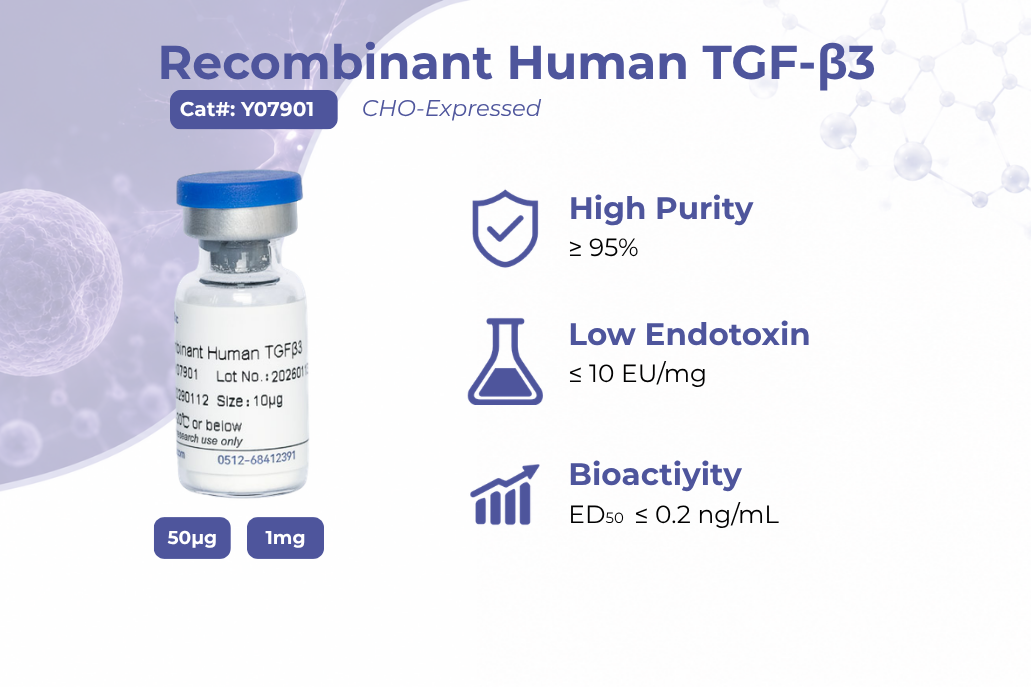
Different TGF-β isoforms can have distinct effects depending on the cell type and developmental stage.For cultivated meat developers, this means that TGF-β1, TGF-β2 and TGF-β3 may be investigated for different applications, particularly when moving from proliferation toward differentiation and tissue formation.
6. Albumin – Protein Carrier and Culture Support
Albumin is another commonly investigated protein component in serum-free cell culture.
It can contribute to protein stabilization, binding of small molecules and maintenance of the culture environment. Published cultivated meat media formulations have included albumin together with insulin, transferrin and growth factors. For animal-free or food-oriented applications, the source and manufacturing process of albumin should be carefully evaluated.
For cultivated meat, biological performance is only one part of the equation. Cost per liter of culture medium is also critical.
A recent analysis of serum-free media for cultivated meat found that growth factors and recombinant proteins can represent a major share of media costs, making optimization and alternative sourcing strategies important for commercialization. A recent 2026 review further highlights that growth factors remain essential—but costly—inputs in serum-free cultivated meat production and emphasizes the importance of redesigning growth-factor production for scalable manufacturing. This creates several priorities for cultivated meat companies:
1. Biological Performance
The protein must provide reliable activity at the required concentration.
2. Batch Consistency
Media performance should remain consistent across different production batches.
3. Supply Stability
Commercial production requires more than laboratory-scale quantities.
4. Manufacturing Scalability
Protein production should be compatible with increasing demand.
5. Animal-Origin Considerations
Animal-origin-free or appropriately controlled raw materials can simplify the development of defined culture systems.
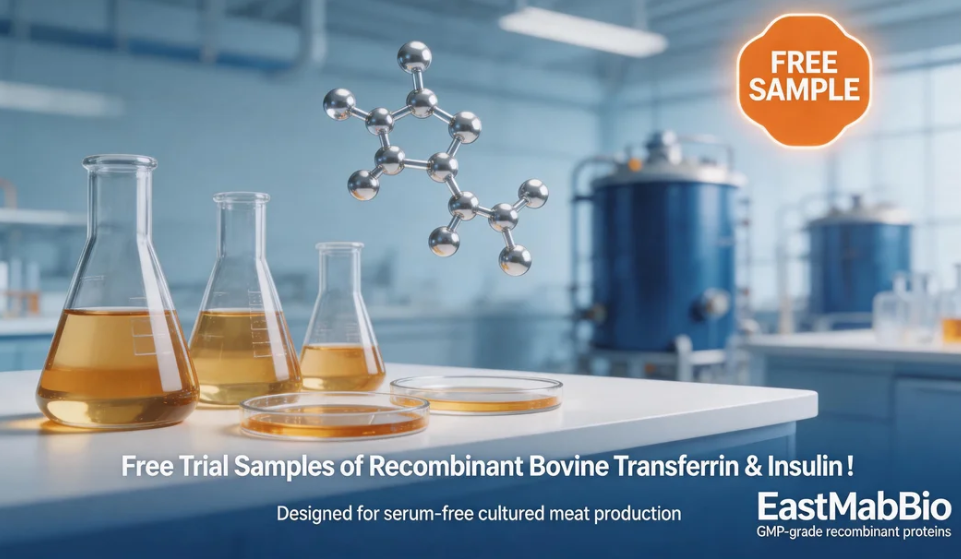
EastMabBio provides recombinant proteins for serum-free cell culture, cultivated meat and cellular agriculture applications.
The portfolio includes Recombinant Insulin, Recombinant Transferrin, Recombinant FGF2/bFGF, Recombinant EGF, Recombinant IGF-I, Recombinant TGF-β1, Recombinant TGF-β2, Recombinant TGF-β3, Recombinant Albumin, Recombinant ECM proteins, Other cytokines and growth factors.
EastMabBio also provides animal-origin-free recombinant protein options, low-endotoxin products, high-purity proteins and scalable supply, helping cultivated meat developers move from early-stage cell culture toward more standardized manufacturing workflows.
The future of cultivated meat will depend not only on cell lines and bioreactors, but also on the development of high-performance, scalable and economically viable culture media.
Recombinant proteins are an important part of this equation. From insulin and transferrin to FGF2, IGF and TGF-β, each component can contribute to the biological performance of the culture system. At the same time, manufacturing cost, supply stability, quality consistency and raw-material requirements must all be considered. For cultivated meat developers, the goal is not simply to make cells grow. The goal is to build a reproducible, scalable and cost-effective cell manufacturing platform.
Q1: What proteins are commonly used in cultivated meat media?
Common components include insulin, transferrin, FGF2, IGF, albumin and selected cytokines or growth factors, depending on the cell type and culture stage.
Q2: Why is FBS being replaced in cultivated meat research?
Serum-free media can provide more defined composition, improved batch consistency and better control over animal-derived components, which are important considerations for scalable cultivated meat production.
Q3: Why are growth factors expensive in cultivated meat media?
Growth factors are highly active biological molecules, and recombinant production, purification and quality control can contribute significantly to their cost. Growth factors and recombinant proteins can therefore represent a major portion of serum-free media costs.
Q4: Can insulin and transferrin be used together?
Yes. Insulin and transferrin are frequently combined in serum-free cell culture formulations and can provide complementary metabolic and iron-transport functions.
Q5: What should cultivated meat companies consider when selecting recombinant proteins?
Key considerations include activity, purity, endotoxin level, batch consistency, animal-origin status, documentation, supply stability and scalability.
1. Djisalov, M.; Knežić, T.; Podunavac, I.; Živojević, K.; Radonic, V.; Knežević, N.Ž.; Bobrinetskiy, I.; Gadjanski, I. Cultivating Multidisciplinarity: Manufacturing and Sensing Challenges in Cultured Meat Production. Biology 2021, 10, 204. https://doi.org/10.3390/biology10030204
Platform Information Submission-Privacy Agreement
· Privacy Policy
No content yet
Platform Information Statement-Laws and Regulations
· Laws and regulations
Trademark registration of Jiangsu Dongkang Biomedical Technology Co., Ltd.
East Mab
East Mab Bio
东抗生物