
Blog
Recombinant Human LR3 IGF-1: Advanced Bioprocessing and Cell Culture
2026.04.20
Fibroblast Growth Factor 8b (FGF-8b) is one of the most biologically active isoforms within the fibroblast growth factor (FGF) family and has become an essential recombinant protein in stem cell research, neural differentiation, organoid culture, and regenerative medicine. As advanced cell culture technologies continue to evolve, the demand for highly active, serum-free, and GMP-compatible growth factors has increased significantly.
Fibroblast Growth Factor 8b (FGF-8b) is one of the most extensively studied isoforms of the FGF-8 family, playing pivotal roles in embryonic development, tissue patterning, and stem cell differentiation. As a secreted signaling protein, FGF-8b binds to FGF receptors (FGFR1c, FGFR2c, FGFR3c, and FGFR4) to activate downstream MAPK/ERK and PI3K/AKT pathways, orchestrating complex developmental programs.
FGF-8b serves as a crucial anterior-posterior patterning signal during central nervous system development:
Midbrain-hindbrain boundary formation: FGF-8b expression at the isthmic organizer establishes the boundary between midbrain and hindbrain, directing the development of dopaminergic neurons in the substantia nigra and serotonergic neurons in the raphe nuclei.
Cortical patterning: FGF-8b signaling from the anterior neural ridge influences telencephalic regionalization, contributing to the specification of frontal cortical areas.
Cerebellar development: FGF-8b drives granule cell precursor proliferation and Purkinje cell differentiation, making it essential for cerebellar organoid protocols.
During limb morphogenesis, FGF-8b functions as a key apical ectodermal ridge (AER) signal:
Proximal-distal outgrowth: FGF-8b maintains the underlying mesenchymal cells in an undifferentiated, proliferative state, enabling progressive limb elongation.
Digit patterning: Through interaction with SHH (Sonic Hedgehog) signaling, FGF-8b contributes to the establishment of anterior-posterior polarity within the limb bud.
Chondrogenic differentiation: FGF-8b influences the balance between proliferation and differentiation of chondroprogenitors, impacting skeletal element formation.
Researchers studying congenital limb malformations or developing limb regeneration models rely on high-quality recombinant FGF-8b to recapitulate these developmental processes in vitro.
Recombinant Human FGF-8bplays a important rolein organoid research, stem cell differentiation, regenerative medicine, and cancer biology. As advanced cell culture systems continue to evolve, high-quality FGF-8b has become an essential growth factor for improving differentiation efficiency, organoid development, and experimental reproducibility across both basic research and translational applications.
Cerebral Organoids: EastMabBio's FGF-8b is employed in dorsal-ventral patterning protocols to generate region-specific neural organoids. When combined with SHH antagonists, FGF-8b promotes dorsal telencephalic identity, enabling the generation of organoids enriched in excitatory cortical neurons. Conversely, FGF-8b withdrawal combined with SHH activation directs ventral forebrain fates, supporting GABAergic interneuron production.
Limb Bud Organoids: Researchers have recently developed self-organizing limb bud-like structures using FGF-8b, SHH, and BMP signaling gradients. These models provide unprecedented access to study human skeletal patterning diseases and test teratogenic compounds.
Dopaminergic neuron differentiation: FGF-8b, in combination with SHH and ascorbic acid, supports the generation of midbrain dopaminergic neurons from human pluripotent stem cells. These cells are being developed as cell replacement therapies for Parkinson's disease.
Gonadal cell development: FGF-8b signaling is essential for Sertoli cell differentiation and testis cord formation, with implications for reproductive biology research and potential fertility preservation applications.
Cardiac lineage specification: Emerging evidence suggests FGF-8b influences cardiac progenitor development, particularly in the context of second heart field derivatives.
EastMabBio's FGF-8b is manufactured using advanced mammalian expression systems to ensure proper protein folding, post-translational modifications, and bioactivity comparable to native human FGF-8b.
Prostate cancer: FGF-8b is overexpressed in prostate tumors and promotes androgen-independent growth, making it a potential therapeutic target and biomarker.
Breast cancer: Autocrine FGF-8b signaling contributes to tumor cell proliferation, survival, and resistance to endocrine therapies.
Ovarian cancer: FGF-8b expression correlates with advanced stage and poor prognosis, driving angiogenesis and metastatic spread.
Bioactivity: One of the most important factors researchers should evaluate is bioactivity. FGF-8b is a highly potent morphogen involved in complex developmental signaling pathways, meaning insufficient or unstable activity can significantly affect differentiation efficiency and organoid quality. Reliable suppliers should provide validated bioactivity data, including ED50 values and cell-based assay results, to ensure the recombinant protein performs consistently across experiments.
expression system: The expression system used for production is another major consideration. Proper protein folding and structural integrity are essential for maintaining FGF-8b signaling functionality. Recombinant FGF-8b produced using optimized expression and purification systems generally demonstrates stronger receptor binding activity and improved experimental consistency. Researchers working with sensitive neural or stem cell cultures should prioritize suppliers capable of delivering high-purity proteins with minimal degradation products.
Endotoxin: Endotoxin levels are particularly important in stem cell and organoid applications. Even low levels of endotoxin contamination can alter cellular signaling, reduce viability, and interfere with differentiation pathways. High-quality recombinant FGF-8b should therefore be manufactured under stringent quality control standards with low endotoxin specifications suitable for advanced serum-free and chemically defined culture systems.
Batch-to-batch consistency: Batch-to-batch consistency is equally critical, especially for long-term projects involving neural organoids, dopaminergic neuron differentiation, or regenerative medicine workflows. Variability between lots can introduce unwanted experimental fluctuations and compromise reproducibility. Reliable suppliers should provide comprehensive Certificates of Analysis (COA) for every batch, including purity, endotoxin, and bioactivity testing data.
With extensive expertise in recombinant protein manufacturing, EastMabBio provides high-quality recombinant Human FGF-8b designed for neural development studies, organoid culture, stem cell differentiation, and regenerative medicine applications. Manufactured under rigorous quality control standards, EastMabBio FGF-8b features high purity, low endotoxin levels, strong biological activity, and excellent batch-to-batch consistency to support reliable and reproducible research outcomes.
EastMabBio, a manufacturer with a decade of deep expertise in recombinant protein production, offers Recombinant Human FGF-8b specifically designed to meet the stringent demands of developmental biologists, organoid researchers, and cell therapy developers.
EastMabBio's recombinant human FGF-8b is produced under stringent quality control standards:
Parameter | Specification |
Purity | >95% by SDS-PAGE and HPLC |
Endotoxin | <0.01 EU/μg |
Bioactivity | ED50<1ng/mL (NlH3T3 cells cell proliferation assay) |
Formulation | Lyophilized from a 0.22 μm-filtered solution containing 10mM PB,5% Trehalose and 0.01% Tween 80, pH7.4 |
Stability | 36 months at -20°C to -80°C in lyophilized state 6 months at -20°C to -80°C under sterile conditions after reconstitution 7-10 days at 2°C to 8°C under sterile conditions after reconstitution Use a manual defrost freezer and avoid repeated freeze-thaw cycles. |
Each batch is accompanied by a Certificate of Analysis detailing purity, bioactivity, and endotoxin levels data. EastMabBio also offers custom formulation services, including carrier protein addition (BSA or HSA) and custom aliquoting for high-throughput screening applications.
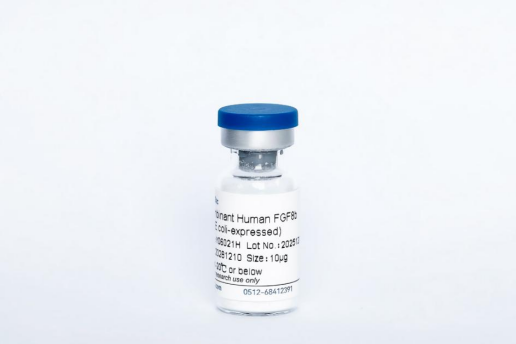
Whether you are investigating neural patterning mechanisms, establishing organoid models, developing cell therapies, or exploring cancer signaling pathways, EastMabBio's high-purity recombinant FGF-8b provides the consistent quality and bioactivity your research demands.
Contact product@eastmabbio.comto request a sample, discuss your specific application requirements, or learn about our comprehensive portfolio of FGF family proteins, including FGF-1, FGF-2, FGF-4,FGF-7, FGF-8b,FGF-9,FGF-10, and FGF-19, to support your complete research workflow.
Q1: What is FGF-8b mainly used for?
FGF-8b is primarily used for neural differentiation, stem cell culture, organoid development, and developmental biology research.
Q2: Is this FGF-8b suitable for serum-free culture systems?
Yes. EastMabBio recombinant FGF-8b is compatible with serum-free, xeno-free, and chemically defined media systems.
Q3: How should recombinant FGF-8b be stored?
Lyophilized protein should be stored at -20°C or below. After reconstitution, aliquot and avoid repeated freeze-thaw cycles.
Q4: What shipping conditions are used?
Products are shipped on dry ice with validated cold-chain packaging to maintain stability during international transportation.
Q5: Do you provide QC documents?
Yes. COA, MSDS,TSE-BSE statements, endotoxin reports, bioactivity data, and additional QC documentation are available upon request.
News
Platform Information Submission-Privacy Agreement
· Privacy Policy
No content yet
Platform Information Statement-Laws and Regulations
· Laws and regulations
Trademark registration of Jiangsu Dongkang Biomedical Technology Co., Ltd.
East Mab
East Mab Bio
东抗生物


