Promotions
NRG1-β1: The "magic factor" in Nerve Cell Culture
2025.04.15
In recent years, hematopoietic stem and progenitor cells (HSPCs) have emerged as an important platform in cell and gene therapy. From conventional hematopoietic stem cell transplantation to autologous HSPC-based gene therapies for diseases such as sickle cell disease and β-thalassemia, and more recently, the clinical application of CRISPR-based gene editing, HSPCs are evolving from cells primarily used for transplantation into an important cellular platform for next-generation genetic disease therapies.
Hematopoietic stem and progenitor cells (HSPCs) are multipotent adult stem and progenitor cells found primarily in the bone marrow, umbilical cord blood, and mobilized peripheral blood.
Their core function is to maintain and replenish the hematopoietic system. HSPCs possess both self-renewal capacity and multilineage differentiation potential, allowing them to generate a broad range of blood and immune cell types, including:
·Red blood cells ·Platelets ·Neutrophils ·Monocytes and macrophages ·Dendritic cells ·T cells ·B cells ·Natural killer (NK) cells
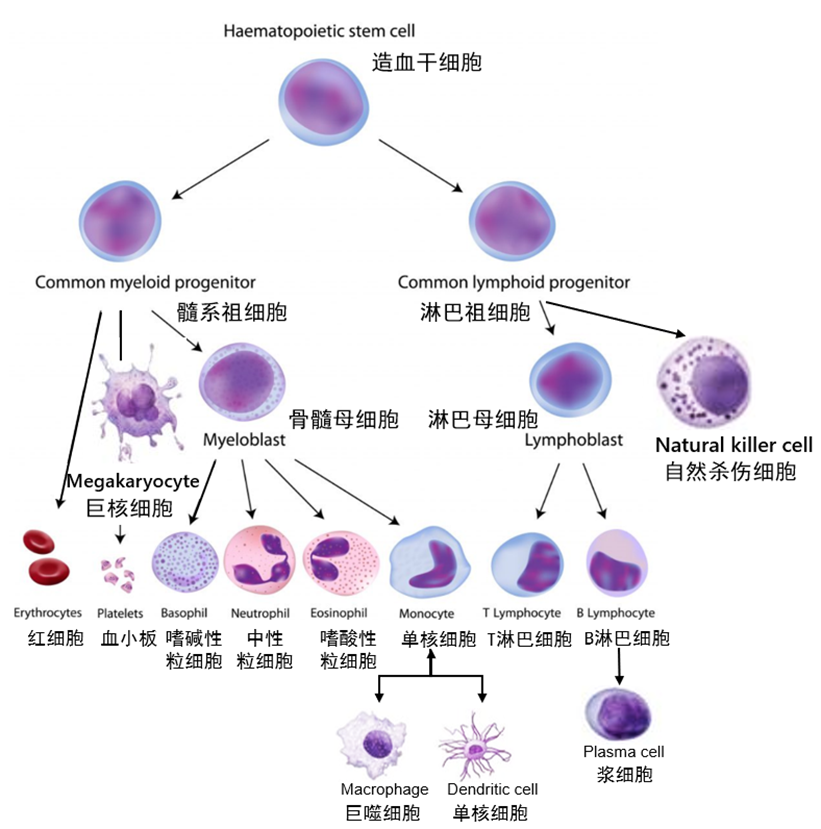
For clinical and research applications, HSPCs can be obtained from bone marrow, mobilized peripheral blood, and umbilical cord blood.
Figure 1. Hematopoietic stem cell differentiation
HSPC-based therapies originated from conventional allogeneic hematopoietic stem cell transplantation (HSCT). HSPCs derived from bone marrow, mobilized peripheral blood, and umbilical cord blood—particularly CD34⁺ HSPCs—have all been used in clinical transplantation to restore hematopoietic and immune function.
However, conventional allogeneic transplantation can be limited by factors such as donor availability, immune incompatibility, and graft-versus-host disease (GVHD).
To address these challenges, autologous ex vivo HSPC gene modification has developed rapidly. In this approach, a patient's own HSPCs are collected, genetically modified ex vivo using viral vectors or gene-editing technologies, and subsequently returned to the patient.
Because the modified cells are derived from the patient's own HSPCs, this approach can eliminate the need for an allogeneic donor and avoid donor-derived GVHD.
HSPC-based gene therapy has now progressed from experimental research toward clinical translation and commercialization. Multiple genetically modified HSPC-based therapies have reached regulatory approval in overseas markets, while several programs in China have also advanced into clinical development.
These approaches are being investigated for diseases including hemoglobinopathies, inherited blood disorders, and congenital immune deficiencies, potentially expanding therapeutic options for patients with genetic diseases.
Figure 2. Approved HSPC-based gene therapy products
| Product | Company | Disease | HSC Technology | First Major Approval |
|---|---|---|---|---|
| STRIMVELIS | Orchard / Telethon | Adenosine Deaminase Severe Combined Immunodeficiency (ADA-SCID) | γ-RV Gene Addition | EMA |
| ZYNTEGLO | bluebird bio | β-Thalassemia (TDT) | LV β-Globin Gene Addition | FDA |
| CASGEVY | Vertex / CRISPR Therapeutics | β-Thalassemia / Sickle Cell Disease (TDT/SCD) | CRISPR/Cas9 Gene Editing | FDA / EMA, etc. |
| LYFGENIA | bluebird bio | Sickle Cell Disease | LV Gene Addition | FDA |
| LENMELDY | Orchard Therapeutics | Metachromatic Leukodystrophy (MLD) | LV ARSA Gene Addition | FDA / EMA |
| SKYSONA | bluebird bio | Cerebral Adrenoleukodystrophy (CALD) | LV ABCD1 Gene Addition | FDA |
| KRESLADI | Rocket Pharmaceuticals | Leukocyte Adhesion Deficiency Type I (LAD-I) | LV ITGB2 Gene Addition | FDA |
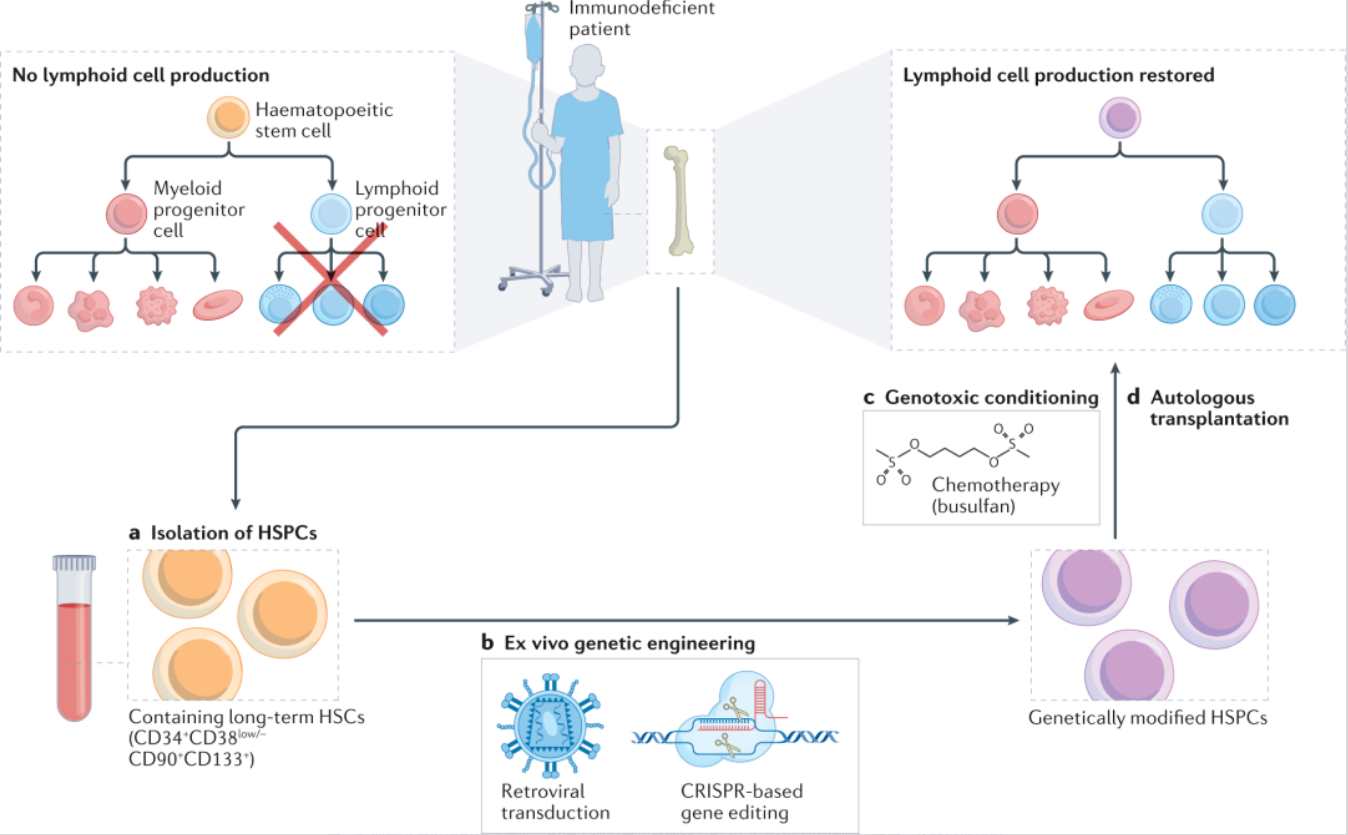
A typical ex vivo HSPC gene therapy workflow involves multiple stages, from cell collection and enrichment to genetic modification, expansion, quality control, and reinfusion.
HSPCs are first collected from the patient or an eligible donor. Depending on the therapeutic strategy, the cells may be obtained from mobilized peripheral blood, bone marrow, or umbilical cord blood.
The collected material undergoes cell isolation, enrichment, and purification to obtain a high-quality HSPC population suitable for downstream genetic modification.
The enriched HSPCs are genetically modified ex vivo using viral vectors or non-viral gene-editing technologies.
For example, CRISPR/Cas9-based gene editing can be used to introduce targeted modifications or corrections to specific genomic regions.
Following genetic modification, the cells may undergo controlled expansion and functional characterization.
Key assessments can include:
HSPC viability
Self-renewal capacity
Multilineage differentiation potential
Genetic modification efficiency
Cellular phenotype
Functional activity
After processing and quality control, the genetically modified HSPCs are administered back to the patient.
Long-term follow-up is then performed to monitor treatment response, immune-related events, engraftment, and long-term safety.
Because these products are intended for clinical applications, the overall manufacturing process requires stringent GMP-compliant controls, quality management, and appropriate release testing to ensure product quality, safety, and consistency.
Figure 3. HSPC clinical manufacturing workflow
As HSPC-based cell therapy, gene therapy, and gene-editing technologies continue to advance, efficient ex vivo expansion and controlled maintenance of HSPCs have become important considerations for research and translational manufacturing.
The composition of the culture environment—including recombinant cytokines and growth factors—can have a significant impact on HSPC survival, proliferation, maintenance, and differentiation.
Supported by an established quality management system, EastMabBio provides a range of recombinant cytokines and growth factors for HSPC culture, expansion, and differentiation research.
Stem Cell Factor (SCF) is an important cytokine used in HSPC culture systems.
SCF can support HSPC survival and maintenance during ex vivo culture and may help maintain cells in a relatively undifferentiated state.
Although SCF alone may have limited proliferative activity on certain primitive HSPCs, it can act synergistically with other cytokines and growth factors, including FLT3 Ligand (FLT3L) and Thrombopoietin (TPO), to support HSPC activation and expansion.
SCF is therefore frequently incorporated into HSPC expansion media and cytokine cocktails.
Thrombopoietin (TPO) plays an important role in maintaining primitive hematopoietic stem and progenitor cell populations.
In HSPC expansion systems, TPO can help support the maintenance of a relatively primitive cellular phenotype and may help limit premature differentiation toward specific hematopoietic lineages.
Maintaining an appropriate balance between HSPC expansion and preservation of stemness is particularly important for applications where long-term hematopoietic reconstitution is a key objective.
TPO is therefore commonly used in combination with other cytokines rather than as a standalone factor.
Fms-like tyrosine kinase 3 ligand (FLT3L) is an important cytokine for the expansion of hematopoietic stem and progenitor cell populations.
FLT3L primarily acts on early hematopoietic progenitors and multipotent progenitor populations and can promote cellular entry into the cell cycle under appropriate culture conditions.
Its effects are highly dependent on the cellular population and cytokine environment. FLT3L is therefore commonly combined with cytokines such as SCF and TPO to establish synergistic HSPC expansion conditions.
Interleukin-6 (IL-6) can function as a synergistic cytokine in hematopoietic cell culture systems.
When combined with early-acting cytokines such as SCF, FLT3L, and TPO, IL-6 may contribute to the transition of HSPCs from a relatively quiescent state into active cell-cycle progression.
IL-6 signaling can also activate downstream pathways, including Akt-related survival signaling, which may contribute to cell survival under appropriate culture conditions.
The optimal concentration and combination of IL-6 should be determined according to the HSPC source, culture platform, and intended application.
For ex vivo HSPC culture, a single cytokine is rarely sufficient to reproduce the complex signaling environment required for maintaining and expanding stem and progenitor cell populations.
Commonly investigated combinations include:
SCF + TPO + FLT3L
and, depending on the experimental objective:
SCF + TPO + FLT3L + IL-6
These cytokine combinations can be further optimized according to:
HSPC source
CD34⁺ cell population
Donor characteristics
Culture medium
Culture duration
Target cell number
Desired stemness phenotype
Intended differentiation or gene-editing workflow
For HSPC gene therapy and CRISPR-based gene-editing workflows, maintaining appropriate cell viability and stem/progenitor characteristics during ex vivo manipulation is particularly important.
EastMabBio recombinant protein products are typically supplied as lyophilized powders.
After receiving the product:
Briefly centrifuge the vial at low speed to collect the lyophilized powder at the bottom.
Add sterile deionized water according to the product instructions.
Gently pipette or mix until completely dissolved.
Avoid vigorous agitation during reconstitution.
Specific reconstitution conditions should be determined according to the individual product specification.
Lyophilized product:
−20°C to −80°C: up to 36 months
After reconstitution:
−20°C to −80°C: up to 6 months
2°C to 8°C: 2–7 days
Avoid repeated freeze-thaw cycles.
Aliquoting the reconstituted protein is recommended when repeated use is expected.
EastMabBio provides recombinant cytokines and growth factors for research applications involving hematopoietic stem and progenitor cells, cell therapy, gene therapy, and ex vivo cell expansion.
Key products for HSPC culture include:
Recombinant Human SCF
Recombinant Human TPO
Recombinant Human FLT3 Ligand
Recombinant Human IL-6
These recombinant proteins can be incorporated into customized HSPC expansion media and cytokine cocktails according to the requirements of different research and development workflows.
From basic HSPC biology to cell therapy process development and gene-editing research, high-quality recombinant cytokines are essential components of controlled ex vivo culture systems.
Hematopoietic stem and progenitor cells are increasingly important in cell and gene therapy, particularly for the development of autologous therapies for inherited hematological disorders.
As HSPC-based therapies progress toward clinical translation and commercial manufacturing, efficient ex vivo culture, expansion, genetic modification, and maintenance of stem/progenitor characteristics remain important aspects of process development.
Recombinant cytokines such as SCF, TPO, FLT3L, and IL-6 provide important signaling inputs for HSPC survival, proliferation, maintenance, and expansion.
By providing a portfolio of recombinant cytokines for HSPC culture, cell therapy, gene therapy, and gene-editing research, EastMabBio supports researchers developing next-generation hematopoietic cell-based technologies.
| Catalog No. | Product | Species | Purity | Endotoxin (EU/mg) | Expression System |
|---|---|---|---|---|---|
| Y03801 | SCF | Human | ≥95% | ≤10 | CHO |
| Y07201 | TPO | Human | ≥95% | ≤10 | CHO |
| Y01201 | FLT3-L | Human | ≥95% | ≤10 | CHO |
| Y02301 | IL-6 | Human | ≥95% | ≤10 | CHO |
| Y02121H | IL-3 | Human | ≥95% | ≤10 | E. coli |
| Y00351H | bFGF | Human | ≥95% | ≤10 | E. coli |
| Y04701 | VEGF165 | Human | ≥95% | ≤10 | CHO |
| Y01501 | GM-CSF | Human | ≥95% | ≤10 | CHO |
Charlesworth CT, Hsu I, Wilkinson AC, Nakauchi H. Immunological barriers to haematopoietic stem cell gene therapy. Nature Reviews Immunology. 2022;22(12):719–733. doi:10.1038/s41577-022-00698-0.
ByDrug / PharmCube. Human High-Quality Cells — Immune Cell Medicine News. Reference source for Figure 1.
Figure 3 source: Charlesworth CT, Hsu I, Wilkinson AC, Nakauchi H. Immunological barriers to haematopoietic stem cell gene therapy. Nature Reviews Immunology. 2022;22(12):719–733.
Platform Information Submission-Privacy Agreement
· Privacy Policy
No content yet
Platform Information Statement-Laws and Regulations
· Laws and regulations
Trademark registration of Jiangsu Dongkang Biomedical Technology Co., Ltd.
East Mab
East Mab Bio
东抗生物